How it works.
Learn → do → make decisions → complete work → get feedback → build a portfolio → become ready. Entirely self-paced, with no cohorts to wait for.
Nine steps from curious to ready.
Free taster
Onboarding plus a few introductory activities in the role.
See how it works
Understand the structure before you pay anything.
Choose your role
Product Manager, UX/UI Designer, Data Analyst or Software Engineer.
Start your quarter
Own the outcome from problem to impact in the Business Quarter for £199.99.
Do the work
Complete realistic simulated tasks, ceremonies and decisions.
Get feedback
AI-supported feedback and assessment against clear rubrics.
Build your portfolio
Every deliverable becomes portfolio evidence.
Prove it
Certificate and verified programme reference on completion.
Optional mentoring
Add paid 1:1 career support whenever you want it.
Every stage, end to end.
01
Try the free taster
Onboarding plus a few introductory activities, with feedback.
02
See how it works
Understand the structure before paying anything.
03
Choose your role
Product Manager, UX/UI Designer, Data Analyst or Software Engineer.
04
Start your quarter
Buy the Business Quarter outright for £199.99.
05
Your first day
A full working day in the team: inbox, team meeting, data, stakeholders and a customer interview.
06
Your complete quarter
Own the outcome and work from problem to impact: discovery, experiments, release and results.
07
Get feedback
AI-supported assessment against defined rubrics.
08
Build your portfolio
Keep every artefact you produced along the way.
09
Certificate + reference
Proof of what you completed and how you were assessed.
10
Prepare and apply
CV, LinkedIn, STAR stories and interview practice.
Not a video, a quiz and a tick.
You're dropped into a situation with competing pressures and asked the only question that matters.
// situation
- ›A stakeholder wants Feature A.
- ›Customer research suggests Problem B is more important.
- ›Engineering has a feasibility concern.
- ›The team's current sprint is full.
- ›Leadership wants measurable growth this quarter.
// the task
What do you do?
Then the simulation plays out the consequences of your decision — and you keep working from wherever that leaves you.
Discovery meets delivery.
Great product teams don't separate thinking from doing. They continuously learn about their customers while delivering value.
// product discovery
Understand:
// agile delivery
Practise:
Discovery helps the team decide what is worth solving.
Delivery helps the team turn learning into outcomes.
The two work together.
We assess how you think, not how much you can memorise.
The question isn't “did you remember the correct framework?” It's “can you make a good product decision?”
// how_you_think
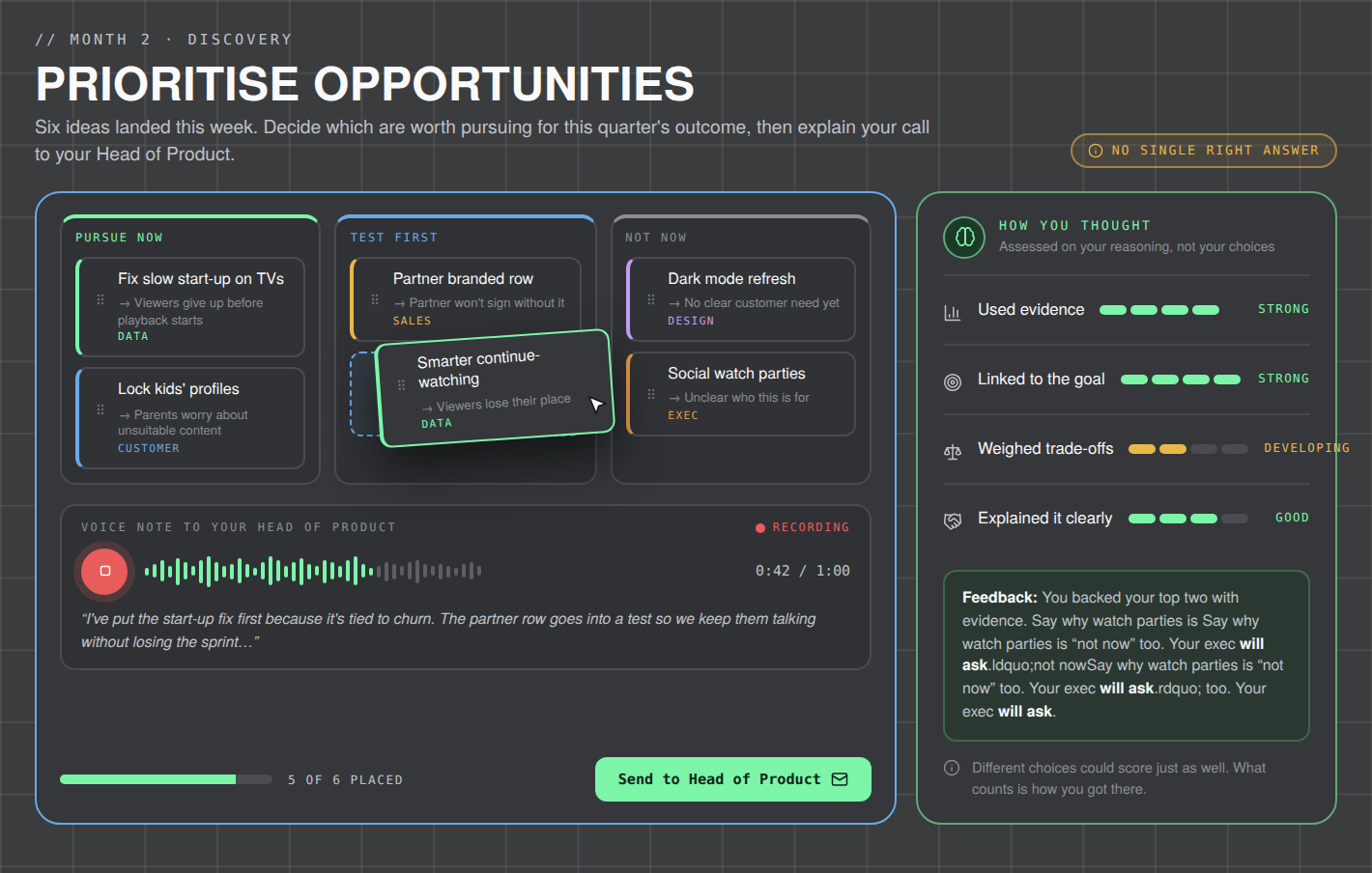
Feedback is a learning aid. It supports your judgement rather than replacing it.
// differentiator
Frameworks are tools. They aren't the job.
Scrum, Kanban, roadmaps, user stories and other tools can help teams organise their work. But no framework can tell you which customer problem matters most, which opportunity is worth pursuing or which trade-off is right for your business.
DoR focuses on the thinking, collaboration and decision-making behind the tools.
// in short
DoR isn't about learning theory. It's about joining a product team, doing the work and making a real impact.
On your first day in the job, nobody hands you a neat backlog. You get an inbox, a manager, customers, pressure and a problem to solve.
Your CV stands out. Your job interview now transformed.
// do the work before you get the job.